Investigador do INET-md convidado para keynote sobre métodos digitais na investigação em música e dança
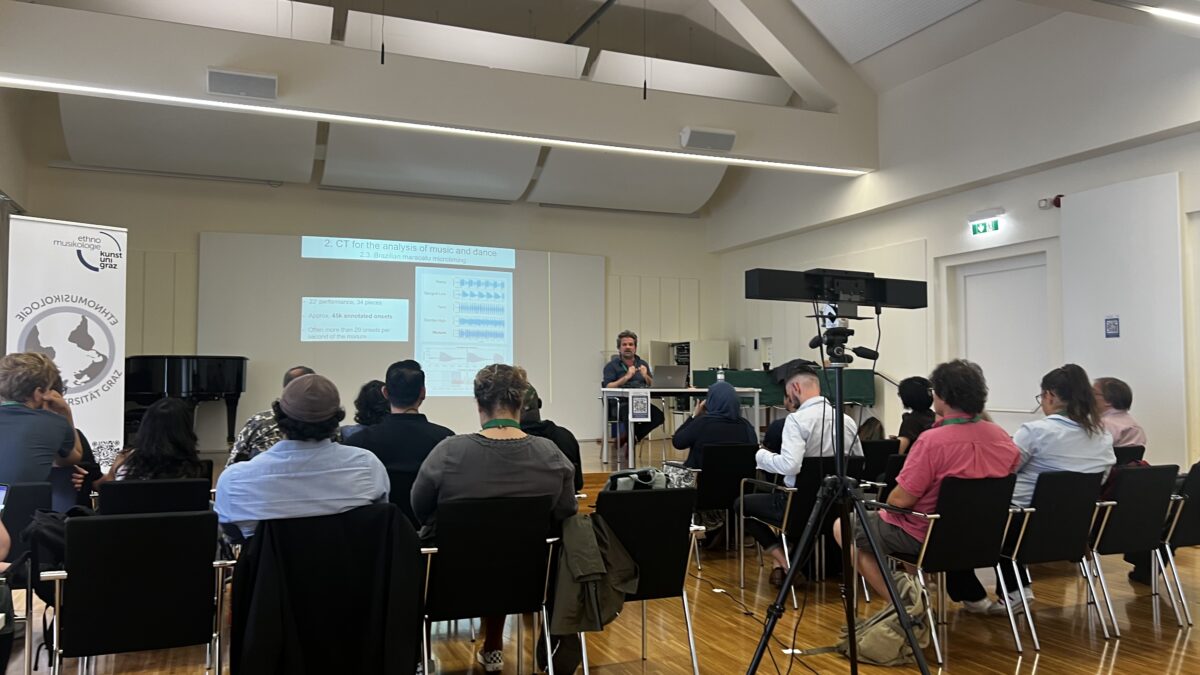
O Investigador do INET-md, Filippo Bonini Baraldi, foi convidado a proferir uma palestra magistral (keynote) no Institute for Ethnomusicology – University of Music and Performing Arts Graz (Áustria), no âmbito do “International Methods Workshop for Early Career Scholars“.
Na edição deste ano, o evento reuniu 30 participantes, metade online e metade presencialmente, e centrou-se em dois temas:
- Coreomusicologia na prática – Como estudar as relações entre movimento e som na etnomusicologia e na etnocoreologia; e
- Métodos assistidos por computador – Como trabalhar com métodos digitais e empíricos na etnomusicologia e na etnocoreologia.
A palestra de Filippo Bonini Baraldi, tida a 23 de Setembro, sob o título “Introduction to digital methods in anthropological music and dance research”, procurou responder a uma série de questões associadas à viragem digital da etnomusicologia:
Ethnomusicologists are nowadays making increasing use of computer-aided methods for analysing different music and dance traditions of the world. At international conferences, we can hear questions such as: “How did you realize that multi-track field recording?”, “Which motion-capture analysis hardware/software do you prefer?” “Can you suggest an efficient micro-timing algorithm?”. This digital turn in ethnomusicology goes along with a renewed effort to analyse the formal properties of the world’s music and dance traditions – intervals and micro-intervals, rhythms and micro rhythms, gestures and micro-gestures – as the emergence of new scientific journals and communities proves (Analytical Approaches to World Music, Empirical Musicology Review, ICTMD Study Group on Sound, Movement, and the Sciences, etc.). In this talk, rather than fully deepening this formalist research strand (which I practice myself, to some degree), I will focus on the ethno-anthropological aims and aspirations of our discipline. Through examples coming from my own research in Romania and Brazil, I will show how computer-aided methods allowed me to explore, and possibly better understand, human behaviours, concepts, and interactions.
Relacionados