


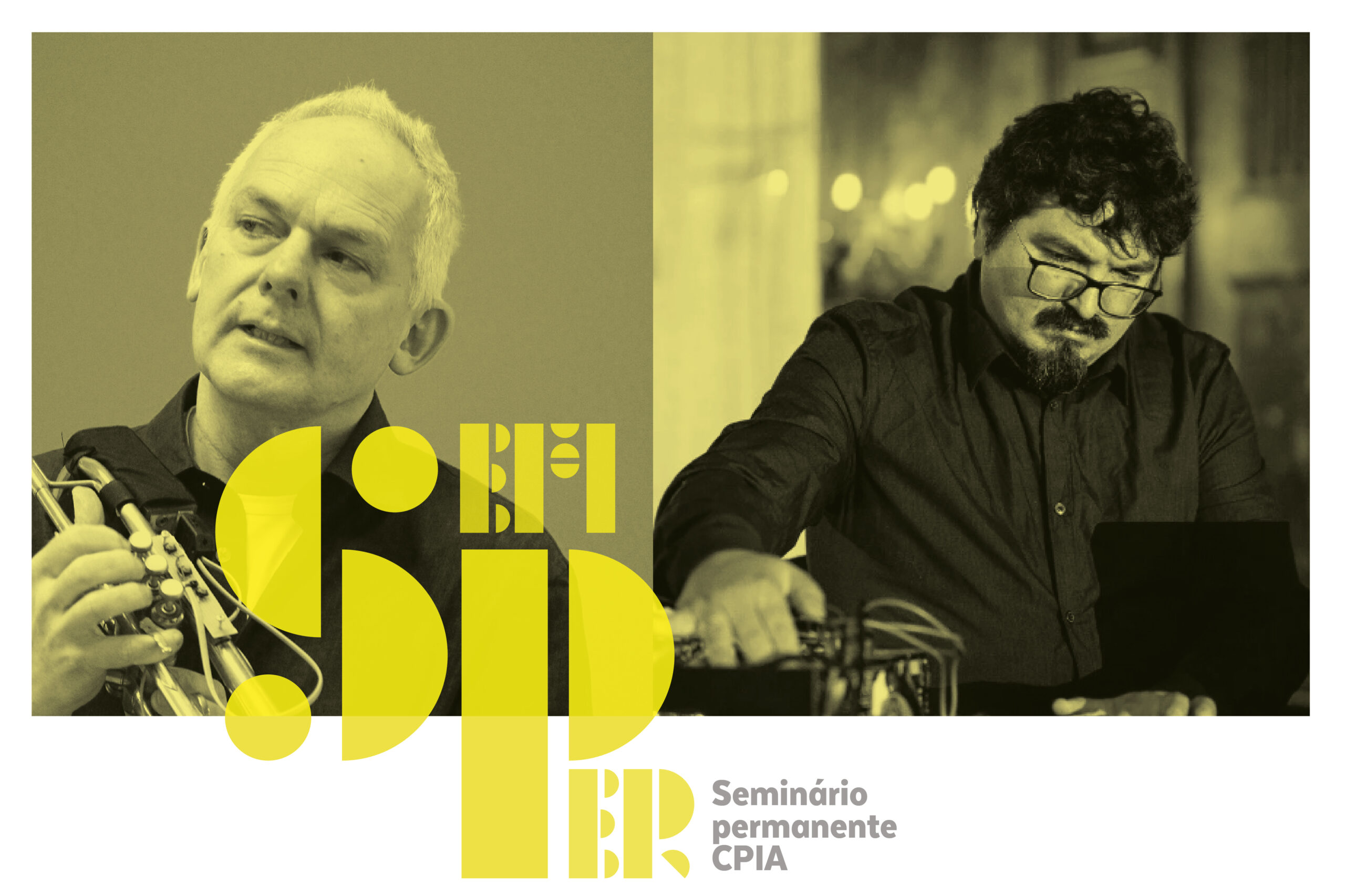
SEMINÁRIO PERMANENTE DO GRUPO DE INVESTIGAÇÃO CRIAÇÃO, PERFORMANCE E INVESTIGAÇÃO ARTÍSTICA
7.05.2026 | 14h – 16h | Estúdio de Som | DeCA
8.05.2026 | 10h – 13h | Estúdio CIME | DeCA
8.05.2026 | 18h | Auditório do CCCI | DeCA
Entrada livre e presencial.
Three States of Wax
Programa
7 de maio
14h – 16h | Estúdio de Som | DeCA
Three States of Wax: the nature of material in improvised electronic music // palestra
Oradores // Jonathan Impett & Juan Parra Cancino (Orpheus Institute)
Jonathan Impett and Juan Parra Cancino will present strategies developed both as part of their Three States of Wax project and within the larger framework of the Music, Thought, and Technology research group at the Orpheus Institute in Ghent, Belgium. These strategies aim to structure improvisation by the use of technologically-informed tropes.
8 de maio
10h –13h | Estúdio CIME | DeCA
Technicity, interaction, AI, and intuitive technology // palestra
Orador // Jonathan Impett (Orpheus Institute)
This presentation sets out a broader view of technology and of the human tendency to exteriorisation, in order to investigate the fundamental technicity of music. This implies a reconfiguration of inherited terms and discourse to find new conceptual models for current practices. Inscription, interaction, and contingency are examined in a wide historical context, and virtuality is shown to be an essential component of music rather than a recent challenge. Case studies include the experience of three decades of evolution of the metatrumpet project, wave phenomena as a mode of understanding time-based media, and new approaches to AI in performative creativity. This is presented in the context of a broader perspective on the relationship between music, technology, and culture.
Interpretation and new performativity in early fixed-media electronic music // palestra
Orador // Juan Parra Cancino (Orpheus Institute)
In this presentation, Juan Parra Cancino will look at the relationship between composers and the tools and techniques used in the studio to create seminal works of electronic music during the1950s, 60s, and 70s. This will highlight the tension between creative intention and technical affordance. Identifying those elements and the performative and experimental actions conducted at the studio during the creative process. Starting from the notion of the electronic music practitioner as a three-folded role, he will present different strategies towards the performance with electronics today, approaching with current technology early repertoire, seeking analogous ‘points of breaking’. This is to transport to the current time the creative/technological tension of the original pieces, while translating from the studio to the stage (some of) the performative actions.
18h | Auditório do CCCI | DeCA
Three States of Wax // concerto
Artistas // Jonathan Impett & Juan Parra Cancino (Orpheus Institute)
Three States of Wax is a project of the ‘Music, Thought and Technology’ research group at the Orpheus Institute, Ghent, Belgium (MTT). The late philosopher of science Michel Serres drew many of his metaphors from music or from the natural world. In L’interférence (1972), he sought to identify the objects of study of modern science and looked back to Descartes’ example of a piece of wax. Early modern science would have described it in terms of its shape, colour, and texture, says Serres – a geometrical description. In the later nineteenth and early twentieth centuries, they would have referred to its properties of heat transmission, deformation, and transformation – physical description. Now, he says, we would more appropriately find an informational description. We should understand it as a carrier and embodiment of knowledge: the feeding habits of the bees, the conditions of its formation, the process of its separation, the entire history of its subsequent use, handling, and environments. And in doing so, we add to that history; every interrogation and knowledge-use becomes part of the material. Three States of Wax considers improvisation in that light: how can the human and computational responses to material generated in improvisation be based not only on figural or gestural interpretations, but on an understanding of that material as embodying a broader history and environment of its emergence? In Serres’ terms, as the product of a time-based, situated modulation or interference pattern of heterogeneous sources of information?
Jonathan Impett | Jonathan Impett studied at Goldsmiths, London, the Royal Academy of Music, Schola Cantorum Basiliensis, City University and the University of Cambridge. As a trumpet player and composer, his work explores the performance and score, between idea and act. Technology has played a major role in the development of such new forms: Artificial Life, AI and machine learning systems are used to investigate new ways of situating and distributing the activities of music. A recent CD release on Attacca Records features his work with the computer-extended ‘metatrumpet’ – a long-term project – and compositions that develop historical material (Machaut, Guerrero). A current series of works Folto Giardino situates ensemble performance in sound installations. He has given premieres of solo works by composers such as Berio, Finnissy, Harvey and Scelsi. He is also a member of the Orchestra of the Eighteenth Century and the Amsterdam Baroque Orchestra, as well as the experimental music group Apartment House. As Director of Research at the Orpheus Institute, he also leads the research cluster Music, Thought and Technology, which posits a fundamental relationship between these three aspects of human behaviour. It explores the hypothesis that at any given cultural moment, models derived from the science and technology of that time play an important role in the imagining and understanding of music. Taking its cue from recent research in technology theory, in new media and digital culture, MTT proposes a radical reorientation of the space and terms in which we think about music, exploring these ideas through creative projects. A monograph, Luigi Nono and Musical Thought, will be published by Routledge in 2018. Jonathan is also an Associate Professor in Music at Middlesex University, London.
Juan Parra Cancino | Juan Parra Cancino studied Composition at the Pontifical Catholic University of Chile and Sonology at the Royal Conservatoire in The Hague, where he completed a Master’s degree focused on electronic music composition and performance. In 2014, he earned a PhD from Leiden University with the thesis “Multiple Paths: Towards a Performance Practice in Computer Music.” As a guitarist, he was involved in Robert Fripp’s Guitar Craft, performing with ensembles such as the Berlin Guitar Ensemble, the Buenos Aires Guitar Ensemble, and the League of Crafty Guitarists. His work spans electronic and electroacoustic music for soloists and ensembles, presented internationally at major festivals. He received distinctions at the Bourges electroacoustic music competition and was featured in the album “50 Years of Electroacoustic Music in Chile,” which won the Quartz Prize. He is a founding member of The Electronic Hammer and performs in WireGriot and Three States of Wax. His work in live electronics has been supported by Dutch cultural funds and has led to teaching and research engagements at institutions including Stanford University, Oberlin College, Banff Centre for Arts, and Tokyo University of the Arts. He has also held composer residencies internationally. Since 2009, he has been a research fellow at the Orpheus Institute, focusing on creativity and performance in electronic music. He currently serves as Regional Director for Europe of the International Computer Music Association (2022–2026).