


Nádia Moura, Pedro Fonseca, Bárbara Magalhães, Marc Vidal, Sofia Serra (investigadora integrada do INET-md) e João Paulo Vilas-Boas assinam o artigo “Postural adaptations of saxophone players during music performance”, publicado em acesso aberto na revista Journal of New Music Research.
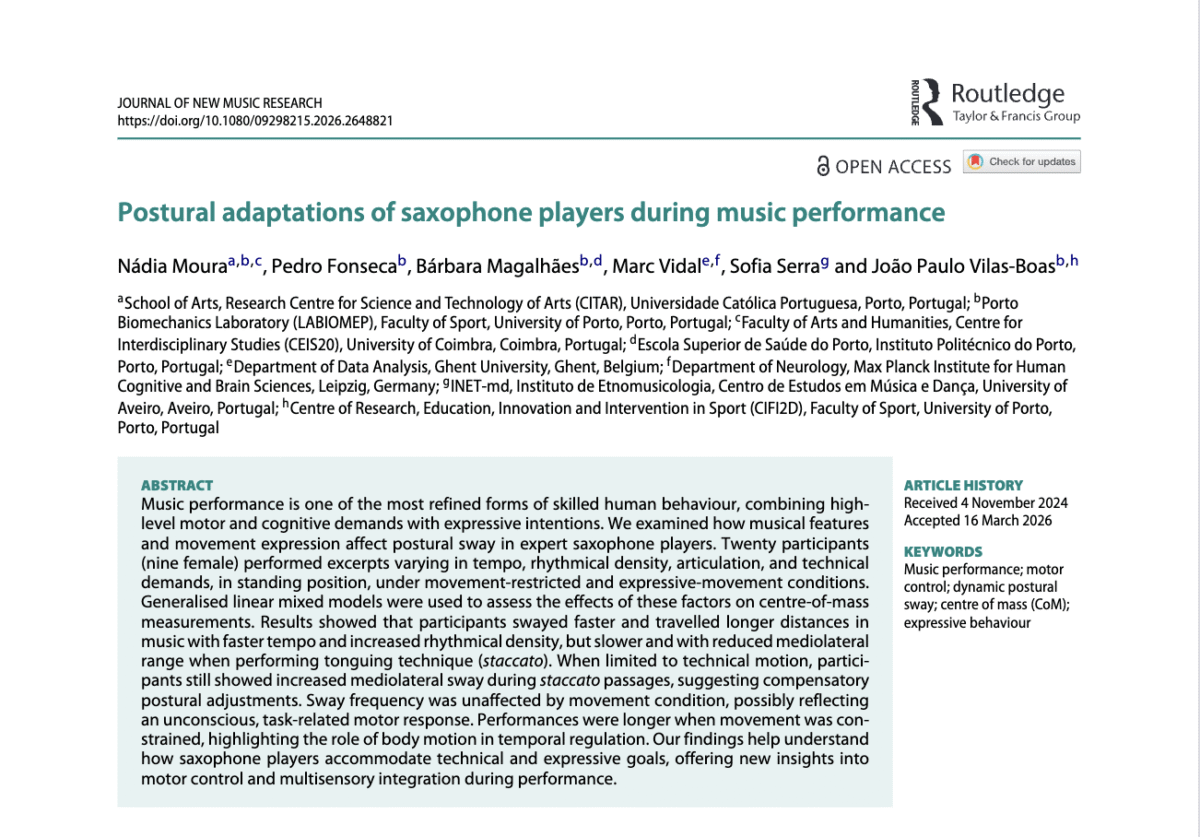
Resumo (apenas em inglês)
Music performance is one of the most refined forms of skilled human behaviour, combining high-level motor and cognitive demands with expressive intentions. We examined how musical featuresand movement expression affect postural sway in expert saxophone players. Twenty participants(nine female) performed excerpts varying in tempo, rhythmical density, articulation, and technicaldemands, in standing position, under movement-restricted and expressive-movement conditions.Generalised linear mixed models were used to assess the effects of these factors on centre-of-massmeasurements. Results showed that participants swayed faster and travelled longer distances inmusic with faster tempo and increased rhythmical density, but slower and with reduced mediolateralrange when performing tonguing technique (staccato). When limited to technical motion, partici-pants still showed increased mediolateral sway during staccato passages, suggesting compensatorypostural adjustments. Sway frequency was unaffected by movement condition, possibly reflectingan unconscious, task-related motor response. Performances were longer when movement was con-strained, highlighting the role of body motion in temporal regulation. Our findings help understandhow saxophone players accommodate technical and expressive goals, offering new insights intomotor control and multisensory integration during performance.