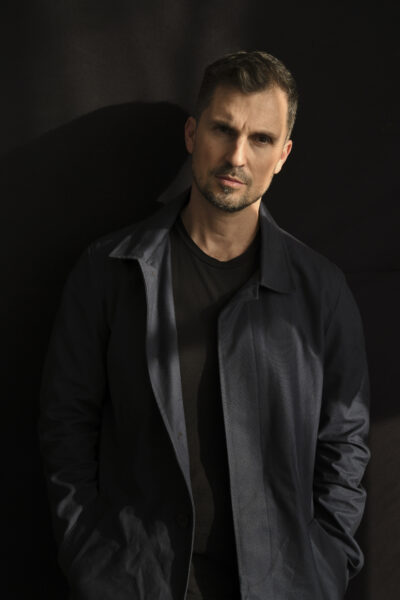
Portuguese-British-Israeli d’Or studied at the Jerusalem Music Academy (BMus), Tel Aviv University (EMBA) & Guildhall School of Music and Drama in London (LGSMD), receiving the International Vocal Art Institution Prize, Ripasso Rising Star Award, and the Gottesman Award.
His operatic repertoire includes Handel’s Gulio Caesar, Ptolomey, Rinaldo, Medoro (Orlando), Jehoyakim (Susannah) and Aresemennes (Xerxes), Gluck’s Orfeo, Cavalli’s Orion and Delfa (Giasone), Purcell’s Sorcerer and Spirit (Dido and Aeneas), Britten’s Oberon (A Midsummer Night’s Dream), Voice of Apollo (Death in Venice), Henze’s Artemis (Phaedra), Vivaldi’s Melindo (La verita in Cimento) and most recently Solomone Rossi in ‘The Siblings of Mantua’ – a unique production of Drottningholm Slottsteatre Stockholm featuring Solomone Rossi, Claudio Monteverdi, Traditional Sephardi Ladino and d’Or’s compositions in the presence of HM King Carl Gustaf of Sweden.
In concert he performs Lieder, oratorios, and traditional repertoire at venues such as the Mariinsky Theatre in Saint Petersburg, Wigmore Hall, Barbican Centre, Royal Festival Hall and Queen Elizabeth Hall in London, York Minster Cathedral, Oslo Opera House, AMUZ Antwerp, Palau de la Musica Barcelona, Casa de Musica Porto, Dome des Invalides and Philharmonie de Paris. A prolific recording artist, Yaniv d’Or is the recipient of the Gramophone Award for his album Liquefacta Est… with Ensemble NAYA and BBC Magazine’s Album Choice for Latino Ladino.
Doctoral project
Título
Tolerance of Old & New Sephardic Music
Advisor
António Chagas Rosa
Co-advisor
Susana Sardo e Henrique Portovedo
Abstract
My focus as a musician has always been on early music, showcasing my countertenor voice in Renaissance choral pieces and Baroque works such as Bach cantatas, Handel oratorios, operas and Monteverdi madrigals. As a result of my experience, I have identified a personal need to explore through my art the connection between artistry and cultural heritage. This journey led to collaboration and exploration of meaningful themes with several leading international figures and the resulting creation of an ensemble and trilogy of albums on this subject: Album One: “The Melting Soul” A Musical Journey of Heritage and Exile The album Liquefacta Est (“The Melting Soul”) draws inspiration from the Song of Solomon, resonating with the experiences of exiled Sephardic Jews throughout history. Album Two: “Latino Ladino” Songs of Exile & Passion “Latino Ladino ” is the second of the trilogy with Ensemble NAYA, which marks societies cycles, peace and prosperity, cruelty and upheaval. Music throughout this album draws on diverse Semitic and non-Semitic traditions, reflecting the diaspora journey across time. Album Three: “Exaltation” Distance, Humanity & Religion, celebrates the unity within the diaspora and shared aspirations for peaceful coexistence. The title track blends elements from Judaism, Islam, and Christianity through the sacred texts Shema Israel (Hear Oh Israel), Allah Hu (God is Great), and Misericordias Domini (Lords’ Mercy)symbolizing the similarities between cultures.
Considering my previous described experience, and in particular the three albums mentioned, I decided to dedicate my research to encouraging tolerance through old and new Sephardic music. To achieve this goal, I intend firstly to examine lyrics and documents of its practices in the context of the Jewish community of the Iberian Peninsula pre-expulsion 1492. Secondly, it will attempt to use such lyrics in newly composed works representing 500 years of Sephardi heritage. It will then note the extent to which the new compositions affect the collective memory of the audience. Another aim, important no less would be advocating for inclusive and equitable representation. Historically, Sephardic music has been dominated by certain narratives and perspectives, often overlooking the contributions of marginalized communities within the Sephardi diaspora. An objective of the research is to advocate for the inclusion of minority individuals within the Sephardic community and beyond.
Giving the nature of my research and goals, I blend multiple methodologies to suit the proposed research in the following aspects: Practice-Based Research: Involves composing as the primary means of investigation. The composition itself becomes the research, with reflecting on and documenting the process of making. This can lead to new insights, techniques, or conceptual frameworks. Participatory Research: Engages audiences or communities as active participants in the research, often through collaborative performances or interactive experiences. The goal is to understand perspectives and generate knowledge together which enables to lean upon collective memory while composing. Historically Informed Research: Sephardi music is characterized by the use of modal structures such as the Hijaz, Nahawand, and Bayat modes, often feature microtonal inflections and elaborate melodic ornamentation, lending a distinctive sound. Various rhythmic patterns that reflect the cultural influences of the Sephardi diaspora, including North African, Middle Eastern, and Balkan traditions. Theoretical Research: Analyzing existing theories, philosophies, and discourses related to music and aesthetics. I intend to use these as a lens to critically examine my own composition and maybe even propose new frameworks. Phenomenological Research: focuses on describing and interpreting the lived experience of my performances and the audience in encountering old and new compositions.
Exploration of the historical basis of Sephardic music as it relates to the tolerance of religious communities in the 15th century Iberian Peninsula, providing a foundation for the development of modern musical compositions drawing on like resources. Producing new knowledge that can serve as an advanced springboard for future research. Production a full-length album featuring new musical compostitions. Establishing a collective memory that contributes to the development of a modern Sephardic identity.
Personal research into Sephardi heritage has led to a profound cultural reconnection, personal resonance, musical innovation and a strengthened sense of artistic identity rooted in the richness of ancestral traditions. This journey has been both creatively and emotionally transformative, empowering to honour the past while shaping new artistic expressions for the future. The immersive study of Sephardi music traditions has facilitated a nuanced appreciation for the rich cultural legacy of the Sephardi diaspora and gained insight into how Sephardi music embodies the history, spirituality and resilience of communities dispersed across the Ottoman Empire, North Africa, the Balkans and the Americas. As someone with Sephardi ancestry, this research has sparked a profound personal resonance, allowing to reckon with familial histories and feel a renewed sense of belonging to a transnational cultural continuum. Creative work has taken on an intimate, almost ancestral quality that channelled the voices and lived experiences of the Sephardi forebears. Integration of traditional Sephardi musical elements into original compositions, fusing time-honoured modalities with contemporary compositional approaches. This blending of the traditional and the modern aims to honour the reverence of Sephardi traditions while also pushing the boundaries of what this music can express in the present-day context.