


Departamento de Comunicação e Arte | Universidade de Aveiro
Campus Universitário de Santiago
3810-193 Aveiro
Portugal
Email: joaopereirasantos@ua.pt
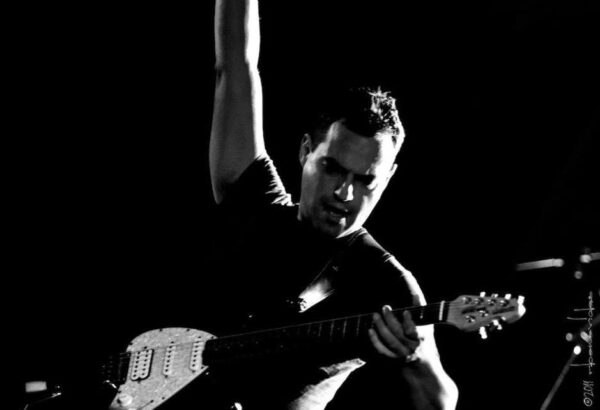
Rui Machado
Rui Machado is a Music Theory and Aural Skills teacher at the Conservatório Regional do Algarve Maria Campina, in Faro, where he is also involved in directing vocal and instrumental ensembles. He holds a degree in Music Education from Instituto Superior Dom Afonso III (INUAF) and a Master’s degree in Music Education from Universidade Católica Portuguesa. He is currently pursuing a PhD in Music at the University of Aveiro.
His professional experience combines more than two decades of teaching in specialised music education with a career of approximately 30 years as a professional musician. The interplay between these two areas has fostered a particular interest in rhythmic learning processes, motor coordination, and musical practice in educational contexts.
His doctoral research focuses on Bimanual Technique as a rhythmic preparation strategy for instrumental learning, exploring the relationship between rhythm, movement, coordination, and musical learning.
Doctoral project
Title
A Técnica Bimanual como Estratégia de Preparação Rítmica para a Aprendizagem Instrumental
Advisor
Nuno Aroso, advisor (UA/INET-md)
Sofia Serra, co-advisor (UA/INET-md)
Helena Caspurro, co-advisor (UA/INET-md)
Abstract
This project seeks to understand how rhythmic preparation before engaging with a full music score can support the learning process for new repertoire. The study was inspired by the fact that many students have difficulty maintaining factors such as pulse, coordination of both hands, and fluency of performance during the initial phases of learning a new instrumental piece. In response to this, a pedagogical intervention will be implemented based on Bimanual Technique, comprising a series of rhythmically coordinated exercises performed with both hands during Music Theory classes, before instrumental performance. The project will involve approximately 30 students enrolled in a basic music course at the Conservatório Regional do Algarve Maria Campina (CRAMC), divided into an experimental group and a control group. Data will be collected through structured observation, audio and video recordings, and semi-structured interviews with both teachers and students. The focus will be on indicators such as temporal organization, motor coordination, and the processes involved in the early stages of acquiring new repertoire. It is expected that the results may contribute to a better understanding of the role of rhythmic preparation developed in Music Theory classes for instrumental learning, and provide guidelines for the use of the Bimanual Technique as a pedagogical strategy linking Music Theory classes and instrumental instruction.
Keywords
Bimanual Technique; Music Theory classes; rhythmic preparation; instrument learning; motor coordination; pulse stability.