


Departamento de Comunicação e Arte | Universidade de Aveiro
Campus Universitário de Santiago
3810-193 Aveiro
Portugal
Email: luamclarindo@gmail.com
Tel: (+351) 234 370 389 (ext. 23700)
Luam Clarindo
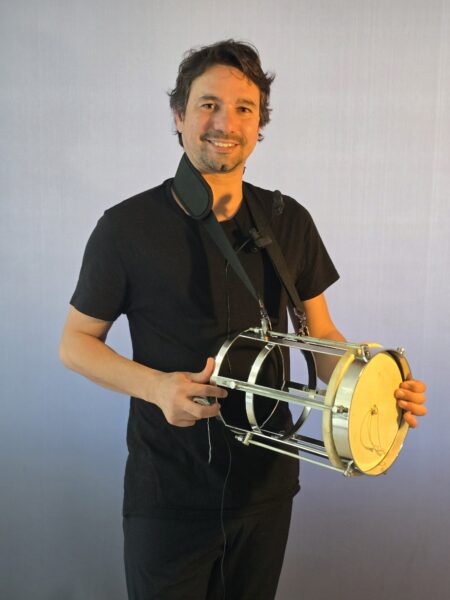
Luam Clarindo is a Brazilian percussionist, improviser, and researcher based in Portugal. He is a PhD student in Artistic Creation at the University of Aveiro and a member of INET-md’s Creation, Performance, and Artistic Research group. His work explores the intersection of experimental music, embodied performance, and digital technology, with a particular focus on gesture-based sonic modulation and hybrid acoustic-digital instruments. His research centers on Hypercuíca, an augmented Afro-Brazilian friction drum combining acoustic performance, motion sensing, and digital signal processing. In 2026, he showcased Hypercuíca at the International Conference on New Interfaces for Musical Expression (NIME 26′), where he also co-authored the paper Hypercuica: Augmenting and Performing with an Afro-Brazilian Friction Drum. His artistic and research activities have been presented in Brazil, Portugal, Germany, Spain, and the UK. Luam holds Bachelor’s and Master’s degrees in Music, specializing in Sound Creation, from the Federal University of Paraná (UFPR), and studied percussion at the Conservatory of Popular Brazilian Music in Curitiba. His practice embraces imagination and free improvisation as fundamental modes of artistic creation.
Doctoral Project
Título
Hypercuíca: Augmenting and Performing with an Afro-Brazilian Friction Drum
Advisor
Nuno Aroso and Filipe Lopes (co-advisor)
Resumo
Keywords