


Departamento de Comunicação e Arte | Universidade de Aveiro
Campus Universitário de Santiago
3810-193 Aveiro
Portugal
Email: paquetehugo@gmail.com
Tel: (+351) 234 370 389 (ext. 23700)
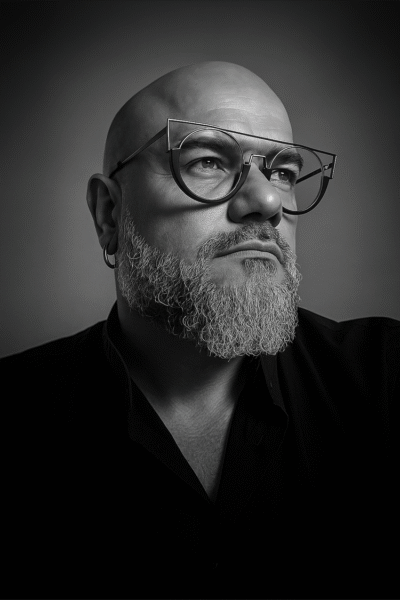
Hugo Paquete
Hugo Paquete is a sonic media artist, composer, and researcher, holding a PhD in Digital Media Art. His practice stands at the interception of contemporary artistic creation and academic research, grounded in experimental and practice-based methods. His internationally recognized work explores the intersection of Sound Studies, media archaeology, and post-digital performance, investigating what he terms the technological unconscious; the hidden systems, codes, and infrastructures that shape contemporary experience across its philosophical, metapolitical, economic, and cultural dimensions.
He is currently a CEEC-FCT Researcher at INET-md (University of Aveiro), where he coordinates the project AI as Catalyst: Transformative Impacts on Digital Performance, Computer Music, and Cultural Creativity (2026). This research develops the concept of the AI-Chimera: a hybrid creative entity emerging from the collaboration between humans and AI systems, challenging the boundaries between author, tool, and collaborator.
His artistic output comprises over 40 works presented in more than 15 countries, distinguished by an experimental methodological approach that articulates algorithmic sabotage and the construction of cybernetic ecologies, immersive sound worlds born from the intra-action between human performers, real-time data streams, generative algorithms, and noise. His work has been presented at institutions such as ZKM | Center for Art and Media (Germany) , Ars Electronica (Austria) , the Museum of Arts and Design (New York) , and the ATLAS Institute (University of Colorado, USA) . He has been an artist-in-residence at ZKM | Hertz-Lab across multiple years (2011, 2018, 2019-2020), where he developed works such as Corpus Pygmalion, Cosmos, and Orbital Eccentricity—the latter with i-Portunus funding and a publication by the Association for Computing Machinery (ACM) .
Among his most emblematic works are: Unevenness (2015), an electroacoustic composition selected by NASA for the OSIRIS-REx mission, currently orbiting the asteroid Bennu; Orbital Eccentricity (2020-2021), real-time sonification of satellite data; Cosmos (2018) and Pulsar (2022), multichannel compositions (48 channels) presented at the ZKM Kubos, Ars Electronica Festival, and the ATLAS Institute; Negentropy: The Last Man in the Wasteland (2024), a multimedia opera integrating AI, scientific visualization, and a custom CO₂-to-MIDI conversion system, funded by DGArtes; ZOE: Actant (2017), an installation sonifying biological processes resulting from a residency at the Hospital do Divino Espírito Santo (Azores); and Talking Doors (2010), an interactive installation created with Julijonas Urbonas, distinguished with an Honorary Mention at Prix Ars Electronica and a Jury Recommendation at the Japan Media Arts Festival.
His research is published in leading forums such as the ACM, with articles introducing concepts like data-sound, and is consolidated in his doctoral thesis Spectral Immanences: Reflection on the Post-Digital in Sound Arts (2022), distinguished with highest honors and funded by the FCT. His career is marked by funding from the most prestigious institutions: Calouste Gulbenkian Foundation, DGArtes, FCT, Creative Europe / CreArt, and i-Portunus. He is the founder and director of Absonus Lab (integrated into the European Media Art Platform) and has teaching experience across diverse contexts and educational levels. Spanning over two decades of activity, his work establishes itself in the panorama of sound art and the disciplinary intersections between art and technology, contributing to critical thought on technology, perception, and agency in the 21st century.
CEEC project
AI as Catalyst: Transformative Impacts on Digital Performance, Computer Music, and Cultural Creativity
AI as Catalyst (2026–2029) is an artistic research project funded by the Portuguese Foundation for Science and Technology (FCT) and developed at INET-md, University of Aveiro. The project explores the transformative role of Artificial Intelligence in Digital Performance and Computational Music, based on three fundamental questions: How does AI redefine the boundary between human and non-human agency in artistic creation? How does the transition from glitch aesthetics to AI-driven probabilistic models take place? And in what ways does AI, as a hyperobject, intersect with data-sound to challenge traditional compositional processes?
The research is grounded in the premise that AI is not merely a tool, but a catalyst that reconfigures contemporary artistic creation. At the core of the project lies the concept of the AI-Chimera: a hybrid creative entity that emerges from the collaboration between humans and AI systems, challenging the boundaries between author, tool, and collaborator. By articulating concepts such as data-sound (Paquete, 2022), cybernetic ecologies, and prompt design as a compositional practice, the research materializes into three practical projects that integrate philosophical and critical reflection, tool development, sonic experimentation, composition, and performance:
Hyperobject Soundscapes explores the sonification of real-time data (satellites, environmental sensors) to create immersive sonic territories in which AI acts as a mediator between the physical world and aesthetic experience, interrogating hybrid agency in sound creation. AI Remix Collective investigates performative collaboration between human musicians and AI within a 3D sonic environment, where prompting becomes a compositional gesture and the machine a co-performer, exploring the emergence of new forms of metacreativity. Glitch Ecology transforms data into audiovisual landscapes, using AI to render the ecological impact audible and to critically reflect on the climate crisis, questioning the role of art in the perception of complex phenomena.
In collaboration with national and international partners, the project asserts the role of sound art as a form of critical thinking on technology, perception, and agency in the 21st century.
Funding
Fundação para a Ciência e a Tecnologia (2024.09158.CEECIND)