


Kalee Rose Prendergast, integrated researcher at INET-md pursuing her PhD at NOVA FCSH, authors the article “Neofalantes, Neogalego e Neofoliados: Music, Dance and Language in Contemporary Galicia“, published by Galicia21 – Journal of Contemporary Galician Studies.
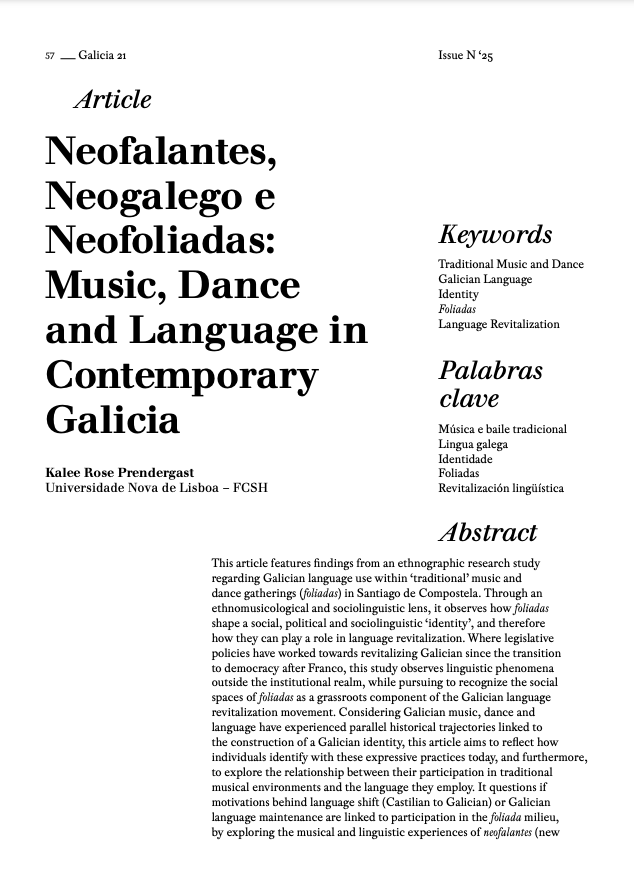
Abstract:
This article features findings from an ethnographic research study regarding Galician language use within ‘traditional’ music and dance gatherings (foliadas) in Santiago de Compostela. Through an ethnomusicological and sociolinguistic lens, it observes how foliadas shape a social, political and sociolinguistic ‘identity’, and therefore how they can play a role in language revitalization. Where legislative policies have worked towards revitalizing Galician since the transition to democracy after Franco, this study observes linguistic phenomena outside the institutional realm, while pursuing to recognize the social spaces of foliadas as a grassroots component of the Galician language revitalization movement. Considering Galician music, dance and language have experienced parallel historical trajectories linked to the construction of a Galician identity, this article aims to reflect how individuals identify with these expressive practices today, and furthermore, to explore the relationship between their participation in traditional musical environments and the language they employ. It questions if motivations behind language shift (Castilian to Galician) or Galician language maintenance are linked to participation in the foliada milieu, by exploring the musical and linguistic experiences of neofalantes (new speakers of Galician) and falantes tradicionais (traditional Galician speakers). Moreover, it considers to what extent these participants’ language choice has an effect on the language use of others outside the traditional music and dance scene. While music, dance and language can all be linked to Galician cultural revival post Franco, the ways in which tradition is being reinvented in/for the 21st century will also be considered. Through participant observation and interviews, these findings provide insight as to how individuals observe their current cultural and social expression. It seeks to establish contemporary practices of ‘traditional’ music and dance as valuable components in Galician language revitalization.