


PERMANENT SEMINAR IN HISTORICAL AND CULTURAL STUDIES IN MUSIC
The Permanent Seminar of the research group Historical and Cultural Studies in Music of INET-md intends to be a forum where all its members (integrated and collaborators), as well as other invited researchers from the academic, cultural and artistic circles, may present their work and discuss ongoing projects and research.
16-06-2026 | 3 pm | NOVA FCSH, Av. de Berna, Lisboa | Tower B – Room B201 & Online
Free access, in person and online:
Meeting ID: 353 035 047 095 512
Access code: Lu7d4Ra3
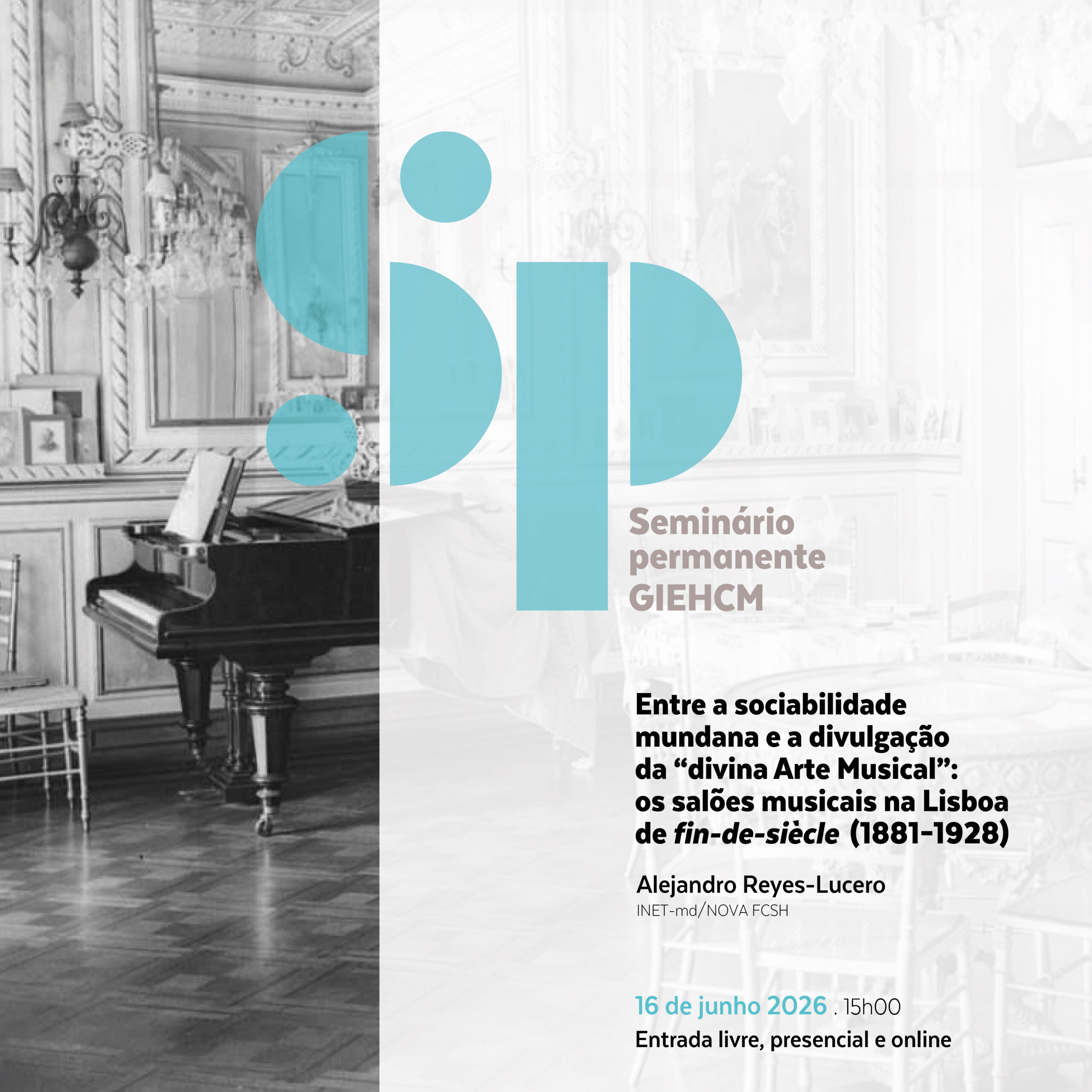
Between Worldly Sociability and the Dissemination of “Divine Musical Art”: Musical Salons in Fin-de-Siècle Lisbon (1881–1928)
Alejandro Reyes-Lucero | INET-md/NOVA FCSH
Music played various roles in shaping the salon sociabilities of the aristocracy and bourgeoisie in Lisbon at the turn of the nineteenth and twentieth centuries. The salons of the Dukes of Palmela and the Counts of Valbom, Ficalho, Magalhães, Daupias and Burnay stand out among the numerous examples of aristocratic households, both of long-established lineage and of recent ennoblement, that hosted grand receptions in the last quarter of the nineteenth century. These worldly soirées included musical performances and extensive dancing entertainments. The repertoires favoured by the guests of these elegant rooms alternated between excerpts from fashionable operas, instrumental pot-pourris inspired by them, and collections of dances — waltzes, polkas, mazurkas, etc. In these salons, music was one of many elements forming part of a complex social apparatus.
With the recitals that began to take place in the salon of the pianist and teacher Alexandre Rey Colaço and at the residence of the Countess of Proença-a-Velha in the late 1890s, new salons emerged in which the aim was to replace worldly entertainments with an active appreciation of music. It was above all amateur women who achieved the greatest prominence in this transformation, finding in musical salons a space for intervention and influence within elite artistic and intellectual circles, as a counterpoint to the rigid social hierarchies that constrained their presence in the public sphere. The varied range of activities that characterised worldly gatherings in which music played a secondary, background role, gave way to programmes centred on the dissemination of works by “classical”, “Romantic” and “modern” composers — the “divine Musical Art” — which demanded attentive and informed listening. This new listening culture crystallised in the organisation of lecture-recitals and concerts conceived as historical cycles or thematic series, complemented by the participation of renowned artists.
For this seminar, I propose to examine how salon practice was characterised in Lisbon during this period, to explore the motivations that led certain agents to feel the need to disseminate “divine Musical Art”, and to assess the role that women played in this process. The selected cases will be organised into three typologies: “worldly-musical” salons — those of Sara Mota Marques and Elisa Baptista Sousa Pedroso —; “atelier salons”, in which music was combined with painting and theatre — those of Adelaide Lima Cruz and Maria Emília Macieira Lino —; and “pedagogical salons”, where the cultivation of music was reinforced through extra-musical devices aimed at raising the level of knowledge of their attendees — those of the Countess of Proença-a-Velha, Alexandre Rey Colaço and Ema Santos Fonseca. It is argued that this typology reveals not only the diversity of musical salon practices in Lisbon, but also the way in which music functioned as a vehicle for cultural distinction and as the affirmation of a deliberate aesthetic and social project, in which women played a central role.
Alejandro Reyes-Lucero | Born in Venezuela (1995), began his musicological studies at the Central University of Venezuela (UCV). He holds a bachelor’s degree in Musical Sciences (2019) and a master’s degree in Historical Musicology (2021) from NOVA FCSH. He is currently a doctoral student in the Doctoral Programme in Musical Sciences – Historical Musicology at NOVA FCSH, benefiting from a scholarship from the Foundation for Science and Technology (FCT) and developing his research work as a member of INET-md Research Unit. His research focuses on private and domestic musical activity in the context of the city of Lisbon between the late 19th and early 20th centuries, with particular emphasis on the case of the music salon of pianist and teacher Alexandre Rey Colaço (1854-1928). Between 2021 and 2022, he participated as a research fellow in the project launched by INET-md, PROFMUS: being a musician in Portugal – the social and professional condition of musicians in Lisbon (1750-1985), based at INET-md and funded by FCT. He has an eighth degree in piano and completed a one-year diploma in Orchestral Conducting at UCV.