


PERMANENT SEMINAR OF THE RESEARCH GROUP ON ETHNOMUSICOLOGY AND STUDIES IN POPULAR MUSIC
The Permanent Seminar in Ethnomusicology and Popular Music Studies, created in 2022, is the central event of the Research Group with the same name. It brings together all its researchers—integrated, collaborating or pursing a PhD—on a monthly or bi-monthly basis. Recent research presented by scholars from within and outside the group, both national and international, is discussed, always maintaining a balance of gender and career levels. The program is curated by Filippo Bonini Baraldi, Andrew Snyder, and Susana Sardo.
28-10-2026 | 4h30 pm | DeCA UA, Aveiro | João Branco Amphitheatre & Online
Free entrance, in presence and online.
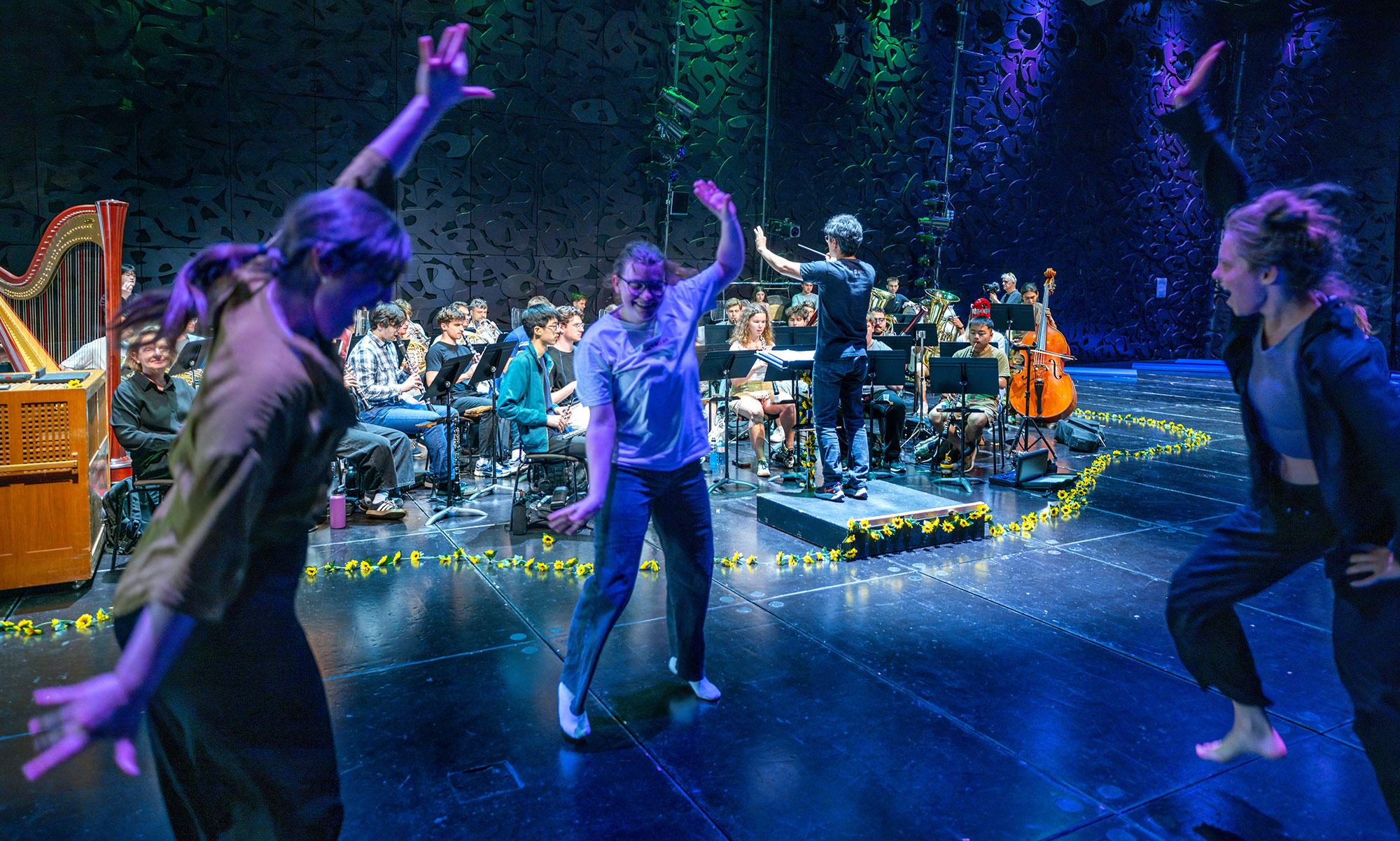
Moving Concert! An Experiment to Merge Classical Concert and Dancehall Vibes
Kendra Stepputat | University of Music and Performing Arts Graz (KUG)
Why do we have to sit still and only clap politely after a piece during a concert of “classical” European music? Why do other concert goers look at us weirdly if the music we listen to moves us and we start to sway on our chairs or move a hand to co-conduct? Would a concert be more joyful if one were allowed to move, and maybe our perception of the music was even more intense?
An experimental concert called the “Moving Concert” carried out at the University of Music and Performing Arts Graz in summer 2026 explored precisely this topic. The KUG Symphonic Wind Orchestra performed a wide range of pieces ranging from Gabriel Fauré to Gordon Jacob with very different musical characters. The pieces were chosen through a collaboration of dance professionals, conductors, and ethnomusicologists, with the aim of inspiring the audience to move. To facilitate this, the audience was encouraged – but never forced – to move freely in the allocated space: Instead of chairs in rows the audience space offered only a few chairs, but also mats on the floor, swings, and a lot of empty space to move in.
In this presentation, I will give an account of the project and its rationale, and share insights from the research that was conducted to understand the inner workings and the potential of a concert during which standard audience behavioral norms were broken and new rules created. Additionally, I will address issues concerning the altered and expanded reception of “classical music” by a diverse audience in an Austrian concert hall context.
Kendra Stepputat | Associate Professor and currently Head of the Institute for Ethnomusicology at the University of Music and Performing Arts Graz (KUG) in Austria. She got her master’s degree in comparative musicology, media and communication science (Freie Universität Berlin) and Southeast Asian studies (Humboldt Universität zu Berlin) in 2003. As part of her studies, she completed a Dharmasiswa scholarship year at the University of Indonesian Arts (ISI) in Denpasar, Bali. From 2003-09 she worked as a research assistant at the Institute for Music, Musicology Department, Martin Luther University Halle-Wittenberg. She completed her doctorate in ethnomusicology at KUG in 2010. From 2016-19 she was holder of an FWF-funded (Austrian Science Fund) Elise-Richter research grant. Her main research interests are Balinese music and dance as well as tango argentino as a translocal practice (habilitation project, completed in 2022), with a focus on choreomusicological research approaches.
She has published in the Yearbook for Traditional Music and in Asian Music. She is co-editor of Sounding the Dance, Moving the Music (with Mohd Anis Md Nor, 2016), Choreomusicology (WOM New Series special double issue 2020 1/2, with Elina Seye) and Perspectives in Motion (with Brian Diettrich, 2021). Her recent book publications are The Kecak and Cultural Tourism on Bali (2022) and Tango Dance and Music – a Choreomusical Exploration of Tango Argentino (2024).
Photo credits © Johannes Gellner, KUG 2026