


Team
Helena Marinho (Coordination and artistic team, INET-md)
António Carrilho (Coordination and artistic team)
Catherine Strynckx (Artistic team)
Sara Carvalho (INET-md, artistic team)
Jônatas Manzolli (INET-md, artistic team)
Olívia Silva (Artistic team)
Francisco Ribeiro (Artistic team)
Ângela da Ponte (Artistic team)
Jaime Reis (Artistic team)
Period
01/2024 to 10/2024
Institutions involved (in collaboration or partnership)
Direção-Geral das Artes (DGArtes)
INET-md
Universidade de Aveiro
La Nave Va – Associação Cultural
Funding
DGArtes 00024325
Abstract
“Remains” explores the topic of sustainability and renewal through the reuse of musical contents discarded by composers, and the implementation of techniques involving common artifacts and other alternative resources in composition and performance. Through artistic research, concert presentations, and mentoring activities, the project aims to establish an innovative artistic analogy with urgent implementation goals for safeguarding.
Keywords
Ecology and art; Portuguese music; Musical experimentation.
Despojos (audio album)
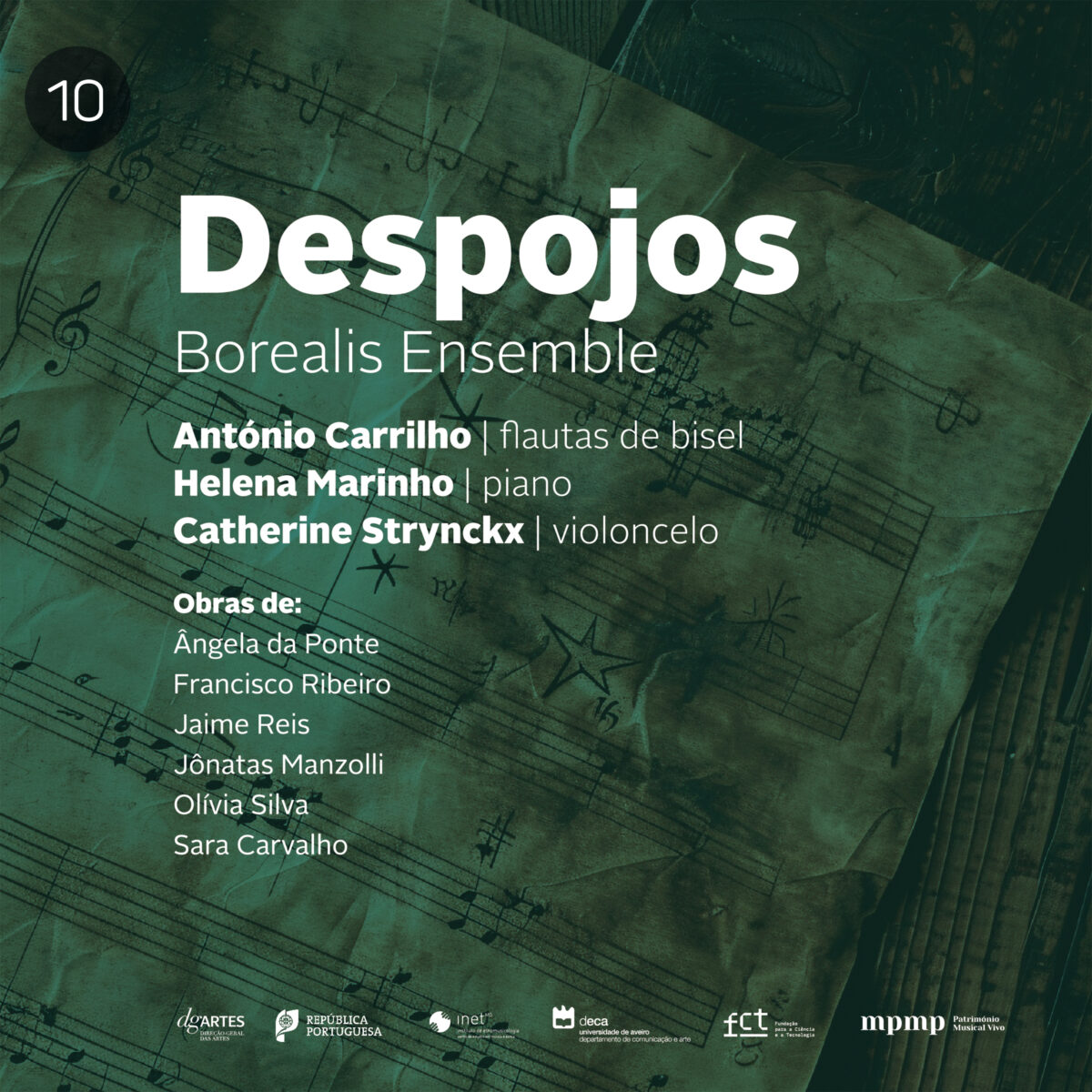
Recorded and published in 2025, with the support of INET-md, available in open access at Despojos – Album by Helena Marinho, António Carrilho, Catherine Strynckx | Spotify.
Performance by the Borealis Ensemble: António Carrilho (recorders), Catherine Strynckx (cello), Helena Marinho (piano).
Works by: Ângela da Ponte, Francisco Ribeiro, Jaime Reis, Jônatas Manzolli, Olívia Silva, Sara Carvalho.
Recording, production, editing, mixing and mastering: Joaquim Branco.
Publisher: mpmp Património Musical Vivo.
Tracks
Olívia Silva – The Sea Organ
Ângela da Ponte – Ombres Résonantes
Francisco Ribeiro – Três Reciclagens
Sara Carvalho – remains
Jônatas Manzolli – Segredos de Aguadeiro
Jaime Reis – emoliente.mavioso.
Bios and works info
She combines her academic research with a performing career as pianist, and this activity informs many of her artistic research outputs. She has presented solo and chamber concerts in main venues and festivals in Portugal, as well as in the USA, Brazil, Colombia, Costa Rica, Ireland, UK, France, Spain, Italy, Greece, Sweden, Norway, Ethiopia, India. Her performing activities include projects with modern piano and fortepiano, and she has recorded (or participated in) 13 CDs, playing Classical and contemporary (acoustic and mixed) repertoire on both instruments. She has also made several recordings for Portuguese radio and television, and French television. She has premièred several contemporary works, and collaborates often with composers from Portugal and other countries. Twenty one of the projects she conceived and performed, which ground her artistic research, have been selected for funding by the Portuguese Culture Ministry.
António Carrilho
The recorder player of the Borealis Ensemble, divides his musical activity between the recorder and conducting. He has appeared as a soloist with the Gulbenkian Orchestra, the Portuguese Symphony Orchestra, the Lisbon Metropolitan Orchestra, Orchestrutopica, Den Norsk Katedralenensemblet (Norway), Sinfonietta de Lisboa, Divino Sospiro, Os Músicos do Tejo, the Haifa Baroque Orchestra (Israel), the Póvoa de Varzim Symphony Orchestra, the Nagoya Baroque Orchestra (Japan), the Cascais and Oeiras Orchestra, Concerto Balabile (the Netherlands), and the Madeira Chamber Orchestra, and has received awards at the international competitions Recorder Moeck Solo Competition (England) and Recorder Solo Competition of Haifa (Israel). He is the musical director of La Paix du Parnasse; a member of the association of Grupos Españoles de Música Antiga; Syrinx: XXII; a member of Chamber Music America; and of Os Músicos do Tejo (Portugal). He is also the principal conductor of the Nagoya Baroque Orchestra (Japan) and performs regularly at major festivals throughout Europe, the Americas, and Asia. He has recorded for the labels Encherialis, Numérica, Naxos, Secretaria de Estado de Cultura do Estado do Amazonas, UA/MPMP, Portugaler, Diálogos, and Arte France/RTP. He teaches courses at the International Early Music Masterclasses of Urbino in Italy, at the Lisbon Masterclasses, and at the International Music Courses of Mateus in Portugal (as co-director), and has led courses and residencies in countries such as Portugal, the Netherlands, Spain, Germany, Italy, India, Japan, and Brazil. He is an Adjunct Professor at ESART — Escola Superior de Artes Aplicadas, where he teaches recorder and chamber music (coordinator of the discipline).
Catherine Strynckx
As a soloist or in chamber music, has performed in prestigious concert halls and festivals in many countries, such as the USA, Germany, Switzerland, the Czech Republic, Slovakia, Argentina, Thailand, Malta, Kyrgyzstan, Peru, Brazil, France, and the Netherlands. She was principal cellist in orchestras in France and Switzerland for ten years, with Camerata Lysy (1989–1992) and the Orchestre des Pays de Savoie (1993–2000), and a member of the Porto National Orchestra (2000–2002). Catherine won first prizes at the International Competitions of Caltanissetta and Trapani, and is a laureate of the Vittorio Gui International Competition in Florence. She was a founding member of the Serenade String Trio, the contemporary music ensemble Sirius, and the clarinet trio A Piacere. She has performed as a soloist and chamber musician in numerous countries. She has recorded several CDs, including Quartet for the End of Time (for the centenary of Olivier Messiaen’s birth), the complete works of Lopes-Graça for string quartet and with piano, and the complete chamber works for strings by Joly Braga Santos. Her most recent recordings include the CDs Escape by the Stretto Duo with Paulo Jorge Ferreira (accordion) and Flutuações with Katharine Rawdon. Her interest in contemporary music has led her to collaborate regularly with composers as a member of the Stretto Duo, Syrinxello, and the Quarteto Lopes-Graça. Catherine Strynckx has extensive experience in cello teaching, having given courses in Thailand, Brazil, Switzerland, Portugal, and Germany, and she is a faculty member of the National Conservatory in Lisbon.
Ângela da Ponte – Ombres Résonantes
Ângela da Ponte is a composer, lecturer at the Conservatory of Vila Real and at the Escola Superior de Música e das Artes do Espetáculo (IPP), and a researcher at CESEM – Centre for Music Studies. Her work has been performed by numerous ensembles including Smirnov Quartet (Basel Music Academy), Remix Ensemble Casa da Música (PT), Oregon Symphony (USA), Vertixe Sonora (ES) and Ensemble New Babylon (DE). Recognition of her work includes performances and premieres at several festivals such as Festival Visiones Sonoras 2016 (MX), Audiokineza (PL), Kulturfabrik – 33.7 Festival (LU), Música Viva Festival 2022 (PT), and various distinctions including representing Portugal at the 67th International Rostrum of Composers (RS), the Ibermúsicas Award – Composition and Premiere of a Work 2022, selection for ISCM World Music Days 2023 in South Africa, and winning the 1st Álvaro García de Zúñiga International Lied Composition Competition.
Ombres Résonantes (Resonant Shadows) is a set of seven miniatures conceived as sonic tributes to composers who passed away recently. Drawing on their legacy, each movement recycles and reinterprets timbres, articulations, gestures, and modes of listening.
Francisco Ribeiro – Três Reciclagens
A percussionist and composer, Francisco Ribeiro began his musical studies in 2011 at the Music School of the Crestuma Philharmonic Society. He completed his bachelor’s degree in Composition at the University of Aveiro with a final average grade of 18 (out of 20). He attended the first year of the Master’s in Music Education, Ensemble Music specialization, under Professor André Granjo. In 2021, the work Esconder é sofrer won the composition competition for Wind Orchestra of the Army Symphonic Band. In 2023, Through my Glassy Veil won first prize at the 11th National Composition Competition of the Portuguese Symphonic Band.
In Três Reciclagens I seek, through the theme of reuse, to work with three melodies representative of each instrument in the trio: for the recorder I use the Allegro from Vivaldi’s Concerto in C [RV 443], seeking to amplify its playful character through imitative discourse and jazz-flavoured harmonies. For the cello I use Le Cygne by Saint-Saëns, transforming its sweet melody into a mournful succession of notes, as if the swan had met a tragic fate. For the piano I use the already tired Für Elise by Beethoven, converting its light melody into a hysterical frenzy, insisting on small fragments of the tune contrasted with intense rhythms. Finally, in the Epilogue, the three melodies are heard simultaneously, in an alternative world where the three can coexist.
Jaime Reis – emoliente.mavioso.
Jaime Reis studied with Karlheinz Stockhausen and Emmanuel Nunes, after training in Composition and Electronic Music at the University of Aveiro with João Pedro Oliveira. He is the founder and artistic director of Project DME and Lisboa Incomum. His instrumental and electroacoustic music has been presented in more than 20 countries. He has worked with institutions and ensembles such as ZKM, IRCAM, Musikfabrik, The Vienna Acousmatic Project, Aleph Guitar Quartet, and Musiques & Recherches. He is Professor of Composition and Electronic Music at the Escola Superior de Música de Lisboa (ESML).
emoliente.mavioso., commissioned by and dedicated to the Borealis Ensemble. In 2018 I began an approach to composition that refers to autotelic processes. The development of the materials derives from elements intrinsic to the work. In the strident rays of a Sun that burns, reverberates and dazzles, the first refreshing breeze of dusk contrasts with the smooth water that shines like skin polished by an emollient action that induces the shimmering of the water and leaves it mellow, gentle and docile.
Jônatas Manzolli – Segredos de Aguadeiro
Jônatas Manzolli is a composer and mathematician whose work bridges art, science and technology. He earned his PhD in Musical Composition at the University of Nottingham (1993) and is a retired Full Professor at UNICAMP, Brazil. He is currently a collaborating researcher at INET-md, University of Aveiro, and CISUC, University of Coimbra. A pioneer in the use of musical computing and robotics in multimodal expression and interactive installations, he created works such as Ada: Espaço Inteligente (Switzerland, 2002) and Re(PER)curso (MACBA, Barcelona, 2007). His instrumental works, presented in Brazil and Europe, include chamber, electroacoustic and symphonic music, as well as three multimodal operas integrating orchestra, dance and digital technology into a single scenic space.
In Segredos de Aguadeiro, recorders, cello and piano intertwine in a sound ecology that recycles two sonic materials. The first, made up of noises, objects and bird calls, refers to the composer’s childhood memories and to the figure of the water carrier in search of springs. In the second, melodic profiles merge into polyrhythmic cycles. Just as the water carrier transports water between different sources, the composer metamorphoses these profiles from one tonality to another. Finally, the opening sounds reappear. In this work, noises and melodies merge into new sonic compounds, forming a fabric in constant transformation.
Olívia Silva – The Sea Organ
Olívia Silva regularly collaborates with various ensembles and musicians in projects covering different instrumental formations, electronic music, installations and dance. She has composed several commissioned works with support from DGArtes for institutions such as Arte no Tempo, DME, DrummingGP, Borealis Ensemble and Cultura em Expansão. One of her ensemble works, Positive messages in a falling apart world, was published in score and CD as part of the project “Creation, Circulation, Audio Recording and Publication of Contemporary Portuguese Music Works,” a collaboration between ESMAE, ESML and the Department of Music of the University of Évora. She attended classes and seminars with Helmut Lachenmann, Johannes Kalitzke, Harrison Birtwistle, Åke Parmerud, among others. She is currently a professor of Music Theory and Analysis, Analysis and Composition Techniques, and other subjects at the Academia de Música de Costa Cabral.
Her work The Sea Organ reflects on the sea as a generating musical force, inspired by the installation in Zadar (Croatia), where wave motion creates sounds through pipes embedded in the seaside steps. The work explores repetition, variation and continuous flow as structural engines, recreating the ebb-and-flow and unpredictability of the sea. It intertwines timbral and rhythmic exploration, reuses fragments of previous works in new contexts — evoking memory and sustainability — and integrates performer improvisation as an essential part of the creative process.
Sara Carvalho – remains
Sara Carvalho is a composer and a senior lecturer at the University of Aveiro, Portugal. She is also fellow researcher at INET-md. As a composer, her work explores gesture, musical narrative, audience-as-performer concepts, and composer-performer collaboration. With over 90 pieces for solo, ensemble, and orchestra, her music is internationally performed, commissioned, published, and available on CD. She is frequently invited to participate in international composition juries. Sara Carvalho actively participates in academic life, serving on international juries, organizing conferences, and contributing to panels. Her research is presented globally and published in journals and books, including with Ashgate/SEMPRE and Imperial College Press.
remains was inspired by the Borealis project “Despojos”, which proposed the reuse of unfinished or discarded musical content. I decided to make a direct connection to this idea, so I reused material that I had abandoned during the development of a past piece, drawing on the concept of “what was left behind.” The title and the musical material also play on the multiple meanings of the word “remain.” In the piece, the initial piano leitmotiv– the one I previously discarded – insists on “remaining,” repeating over and over. This repetition not only conveys the idea of “staying in the same place,” but also alludes to the way history repeats itself and recalls the remains of bodies from recent wars.