


Cristina Fernandes, full researcher at INET-md and coordinator of the research group Historical and Cultural Studies in Music, is the author of the article “«Bailes», Danças e Contradanças nas narrativas dos rituais públicos: alteridades nas representações musicais e coreográficas ao longo do século XVIII” (“Bailes”, Dances and Contredances in the narratives of public rituals: alterities in musical and choreographic representations during the 18th century), published in open access by Revista de História da Sociedade e da Cultura, in a thematic issue devoted to Public Rituals and Alterity in the Portuguese Empire, coordinated by Ângela Barreto Xavier (ICS-ULisboa) and Lisa Voigt (Yale University).
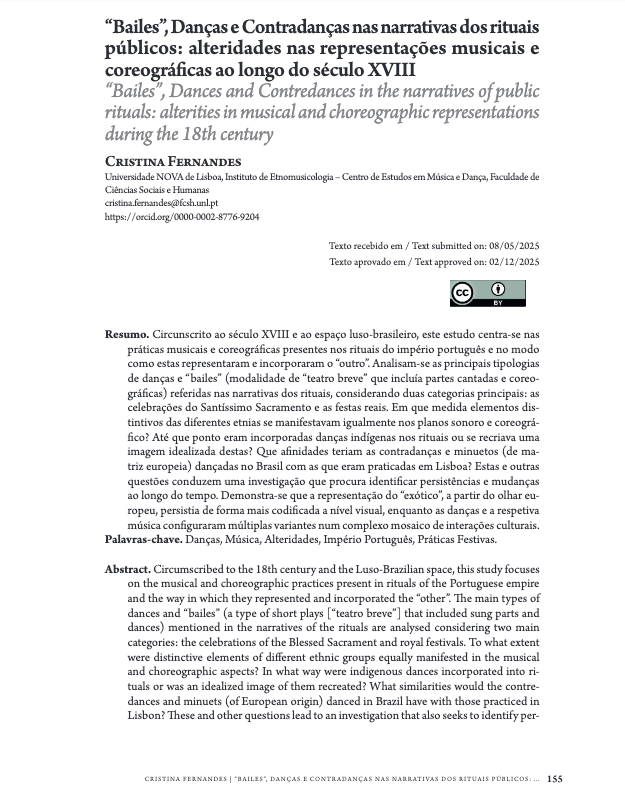
Abstract:
Circumscribed to the 18th century and the Luso-Brazilian space, this study focuses on the musical and choreographic practices present in rituals of the Portuguese empire and the way in which they represented and incorporated the “other”. The main types of dances and “bailes” (a type of short plays [“teatro breve”] that included sung parts and dances) mentioned in the narratives of the rituals are analysed considering two main categories: the celebrations of the Blessed Sacrament and royal festivals. To what extent were distinctive elements of different ethnic groups equally manifested in the musical and choreographic aspects? In what way were indigenous dances incorporated into rituals or was an idealized image of them recreated? What similarities would the contredances and minuets (of European origin) danced in Brazil have with those practiced in Lisbon? These and other questions lead to an investigation that also seeks to identify persistence and changes over time. It is demonstrated that the representation of the “exotic”, from a European perspective, persisted in a more codified form at the visual level, while the dances and their respective music configured multiple variants in a complex mosaic of cultural interactions.