CfP: International Conference “Music and Exile”
INTERNATIONAL CONFERENCE “MUSIC AND EXILE”
21–23 May 2026
NOVA FCSH, Colégio Almada Negreiros (LISBON)
CALL FOR PAPERS until 15 January 2026
The project EXIMUS – “We must warn everyone”: Music and Portuguese exile in France during the Estado Novo regime (1933-1974), funded by the FCT (2022.05129.PTDC), invites the submission of paper proposals for the International Conference “Music and Exile”, which will take place at the Faculty of Social and Human Sciences of Universidade Nova de Lisboa (Colégio Almada Negreiros), from 21 to 23 May 2026.
The impact on musical creation and production of experiences of exile and the forced displacement of individuals and populations – whether in contexts of political repression or armed conflict – has drawn increasing attention from musicology, ethnomusicology, and cultural history. A substantial body of literature already exists on the liminal status of the “nostalgic and sentimental” figure of the exile (Said, 1993), as well as the “condition of duality” inherent to the experience of exile and its consequences for musical creation (Goerh, 1999), particularly in the context of the “musical migration” from Central Europe to the United States during the Second World War (Barilier, 2018). In this context, studies on narratives produced about musical exile have gained particular relevance, especially those identifying processes of “transplantation” or “acculturation” – exemplified by the contrasting experiences of Arnold Schoenberg and Kurt Weill in the U.S., the former marked by artistic isolation and the latter as an example of successful adaptation – as well as the complex aesthetic, political, and biographical negotiations involved in “narratives of return” (Moreda, 2016).
Coinciding with the centenary of the coup d’état of 28 May 1926, which initiated the Military Dictatorship in Portugal and the longest-lasting authoritarian regime in Europe, this international conference aims to contribute to mapping current research on the subject, across different chronologies and geographies, and to propose a multidisciplinary outlook that highlights the diversity of experiences of exiled, emigrated, or refugee musicians on an international scale.
The Scientific Committee encourages the submission of proposals addressing a wide range of research topics:
- Specificities of musical activity in contexts of exile;
- Music, resistance, and activity in political parties;
- Music, freedom of expression, and political repression in exile;
- Internationalism, anti-colonialism, anti-racism, and liberation movements in exile;
- Feminist movements and the question of gender representation in musical production in exile;
- Interactions between exiled musicians and associative, institutional, and political spheres in host countries;
- The influence on musical creation of stylistic and linguistic encounters between exiled musicians of different origins and with the musical life of host countries;
- Connections between music in the context of exile and other arts (theatre, cinema, dance, etc.);
- Connection between exiled musicians and the various industries linked to musical activity (recording, performance, etc.);
- Amateurism and professionalism – the status of musicians’ work in exile;
- The return of exiled musicians to their country of origin;
- Music in different narratives of exile, including the notion of “inner exile”;
- The role of music in preserving the memory of exile (associations, commemorations, educational initiatives);
- The challenges posed by the heritagization of exile memory (archives, documentation centres, museums, festivals).
The Conference will feature the following keynote speakers:
Anthony Seeger | Anthropologist and ethnomusicologist, Professor Emeritus in the Department of Ethnomusicology at the University of California, Los Angeles (USA), and Director of Smithsonian Folkways Recordings at the Smithsonian Institute from 1988 to 2000. He is the author of Why Suyá Sing: A Musical Anthropology of an Amazonian People (Cambridge University Press, 1987) and co-editor of Archives for the Future: Global Perspectives on Audiovisual Archives in the 21st Century (Seagull Books, 2004). His large number of publications have focused on the music and social life of the Kisedje Indians of Brazil, North American folk music, issues of indigenous land and human rights, archiving, intellectual property, intangible cultural heritage, and ethnomusicological theory and method.
Florian Scheding | Musicologist and cultural historian, currently Director of Education at the School of Arts, University of Bristol. His main field of interest is the relationship between music and migration, with a particular focus on the displacement and exile of European musicians throughout the 20th century. He has published on music and migration in its multiple forms, covering functional, popular, and art-music repertoires. He is co-editor, with Erik Levi, of Music and Displacement: Diasporas, Mobilities and Dislocations in Europe and Beyond (Scarecrow Press, 2010) and author of Musical Journeys: Performing Migration in 20th-century Music (Boydell & Brewer, 2019).
The working languages of the “Music and Exile” Conference will be Portuguese, English, French, and Spanish.
Paper proposals should be sent as a Word file until 15 January 2026 to eximusconference@gmail.com including the following elements:
- Title of the paper
- Abstract of up to 3,000 characters (including spaces)
- Short biography of up to 1,500 characters (including spaces)
Notification of acceptance will be sent by email by 6 February 2026.
For more information, contact: eximusconference@gmail.com
Scientific Committee:
- Cristina Clímaco (Université Paris 8/Vincennes Saint-Denis)
- Graça dos Santos (Université Paris Nanterre)
- João Madeira (IHC/NOVA FCSH)
- Manuel Deniz Silva (INET-md/NOVA FCSH)
- Mário Vieira de Carvalho (CESEM/NOVA FCSH)
- Miguel Cardina (CES/UC)
- Salwa Castelo-Branco (INET-md/NOVA FCSH)
- Victor Pereira (IHC/NOVA FCSH)
- Ricardo Andrade (INET-md/NOVA FSCH)
- Hugo Castro (INET-md/NOVA FSCH)
- Agnès Pellerin (INET-md/NOVA FSCH)
Organising Committee:
- Agnès Pellerin (INET-md/NOVA FSCH)
- Hugo Castro (INET-md/NOVA FSCH)
- João Madeira (IHC/NOVA FCSH)
- Manuel Deniz Silva (INET-md/NOVA FCSH)
- Ricardo Andrade (INET-md/NOVA FSCH)
- Victor Pereira (IHC/NOVA FCSH)
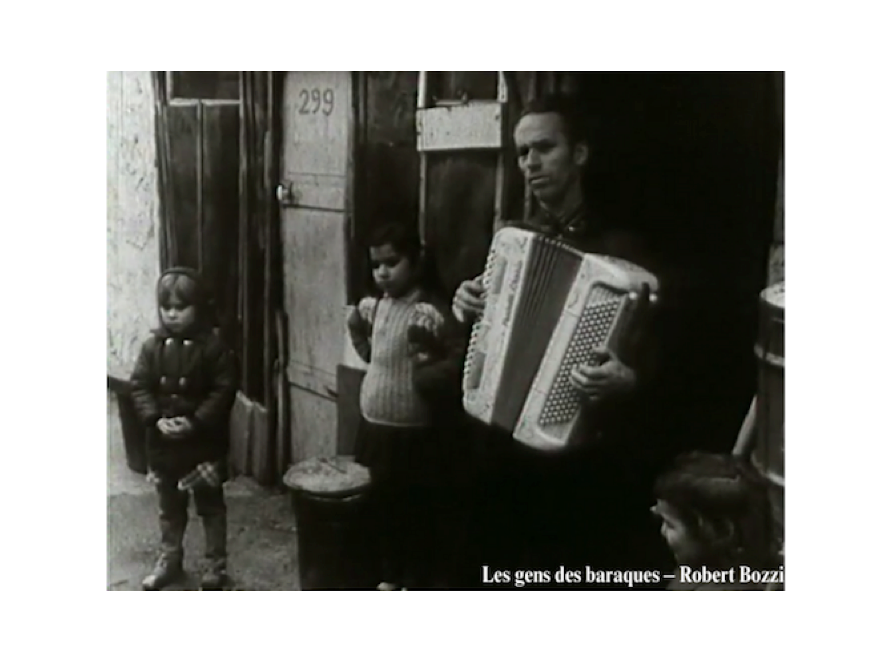
Image: Frame of Les gens de baraques – Robert Bozzi ©
This Conference is funded by national funds through FCT – Fundação para a Ciência e a Tecnologia, I.P., within the project EXIMUS – “We must warn everyone”: Music and Portuguese exile in France during the Estado Novo regime (1933-1974) (2022.05129.PTDC, DOI 10.54499/2022.05129.PTDC), and INET-md, Instituto de Etnomusicologia – Centro de Estudos em Música e Dança (UIDB/00472/2020, DOI 10.54499/UIDB/00472/2020).
Related